
ICE Madison Release Scope
Federal immigration custody is a civil-immigration system. It is not the Madison County jail, a Tennessee state prison, or the Federal Bureau of Prisons. No dedicated ICE detention center was verified in Madison County. A person may still enter ICE custody after release by a local agency, appear at a facility outside the county, report under community supervision, transfer again, or leave ICE custody under another legal posture.
ICE’s Online Detainee Locator System, known as ODLS, answers a limited custody question. Official ICE material states that it includes people currently in ICE custody or released from ICE custody within the last 60 days. That is a real recent-release window, but it belongs only to ICE. It is not Madison County’s missing 24-hour or 72-hour jail release list.
Search ICE Release Records
The ICE Online Detainee Locator offers two search methods. The number route uses the person’s A-number and country of birth. Enter the A-number as nine digits, adding leading zeros where needed. The biographical route uses personal details requested by the live form. Spellings and identity checks matter, especially when names have multiple forms.
- Choose the A-number or biographical route based on the strongest identifier available.
- For A-number search, enter nine digits and the country of birth exactly as required.
- For a biographical search, enter the requested name and birth details and compare all identifiers carefully.
- Read whether ODLS reports current custody or a release within its limited recent window.
- If a documented ICE matter is not resolved, use the official ERO field-office directory and ICE records route.
The public system does not locate people under 18. No youth details should be sought through an adult custody page. Other categories and very recent transfers may also fail to appear. A no-result screen is therefore not proof that ICE never held the person or that release occurred.
Note: After the 60-day ICE window, an ODLS absence cannot establish a historical release date or rule out past immigration custody.
ICE Release Status Meanings
“Released from ICE custody” must be described with care. It can mean release under an order of supervision or check-in terms. It can also precede transfer to another authority, or reflect removal from the United States. Those outcomes have different legal and physical meanings. The locator result should be preserved with its date, then matched with the ICE record that explains the event.
| ICE or county event | What it means |
|---|---|
| Current ICE custody | ODLS reports the person within the immigration detention system |
| Recent ICE release | ICE reports release within the locator’s limited 60-day window |
| County release to ICE | Madison County custody ended and ICE became the receiving authority |
| ICE transfer | Custody or placement changed; it is not necessarily community release |
| Order of supervision | The person is out of detention but remains subject to immigration reporting terms |
| No ODLS result | The public locator did not resolve the search; it is not proof of no custody history |
Use the exact agency language. Do not call transfer a release, and do not call release from detention the end of an immigration matter. A court or agency order explains legal posture. The custodian’s movement record supplies the physical date and destination.
Madison ICE Detainer Releases
ICE’s detainer guidance explains why a person can be “released by Madison County” without entering the community. A detainer asks the holding law-enforcement agency to notify ICE before release. It also requests temporary continued custody for up to 48 hours beyond the time the person would otherwise be released, allowing ICE to assume custody.
The Madison County booking and release sheet should identify the destination or receiving authority when a handoff occurs. Ask MCSO Corrections for the actual release time, disposition code, receiving agency, and transfer date through the county records route. Then search ODLS for the immigration layer. A county record can truthfully show release to ICE while ODLS shows current ICE custody. Both records describe successive parts of one chain.
If the county record shows a detainer but ODLS returns no result, contact ERO and consider timing, spelling, locator exclusions, or another transfer. Do not fill the gap with a guess. The Criminal Justice Complex release record path explains how to obtain the local destination field.
ICE Release Record Contact
No Madison County ICE facility contact should be invented because no dedicated local detention center was verified. The official follow-up route is the ICE Enforcement and Removal Operations field-office directory. Choose the office tied to the documented case or place of custody, not merely the person’s home county. ICE records requests are the historical fallback after ODLS’s recent-release window.
Federal Immigration Custody Routes
Current and recent custody:
ICE Online Detainee Locator System
Locator assistance:
ICE Enforcement and Removal Operations field-office directory
Historical records:
ICE FOIA request process
Madison County location:
No dedicated ICE detention center verified
The official ICE field-office directory is the source of the successful manifest image below.
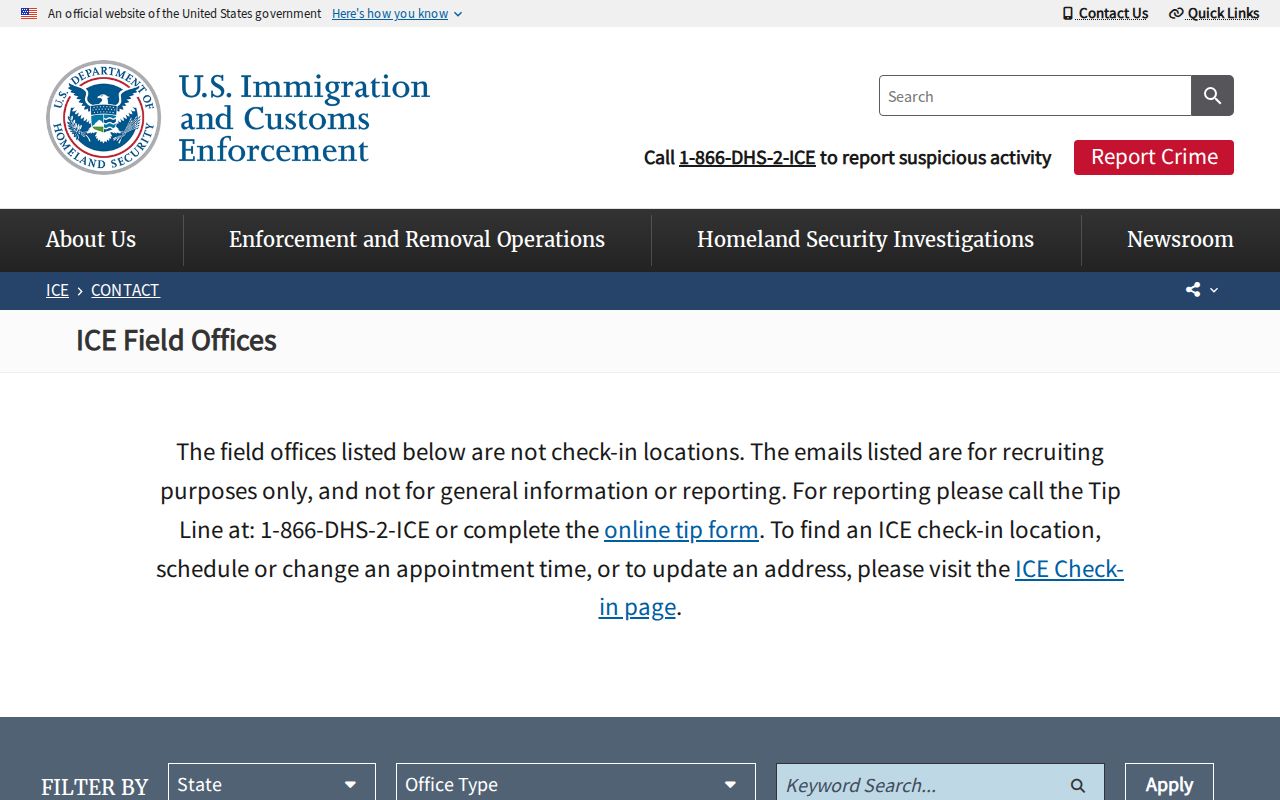
The directory supplies the verified assistance route when ODLS cannot resolve a documented case. It does not establish that a person is or was in ICE custody.
Historical ICE Release Records
ODLS is not a full historical archive. Once a release falls outside its stated window, the person may no longer appear even though ICE once held them. A focused ICE FOIA request is the proper fallback. Provide the strongest lawful identifiers, a bounded date range, the known facility or office, and a clear description of the existing admission, transfer, release, or supervision record sought.
The request should not ask ICE to create a new explanation. Ask for the record that documents the event. If Madison County handed the person to ICE, retain the county record too. It establishes the first transfer. ICE establishes the next stage. A federal court or immigration proceeding may supply legal context but may not give the exact physical movement time.
- A-number
- A federal immigration identifier used in ODLS and agency records; the public locator expects nine digits.
- Detainer
- A request for notice and temporary continued custody so ICE can assume custody.
- ERO
- ICE Enforcement and Removal Operations, the field-office network used for custody assistance.
- Order of supervision
- A form of release from detention that carries ongoing immigration reporting terms.
ICE and Federal Release Paths
ICE and BOP are both federal agencies, but their custody systems are not interchangeable. BOP handles federal prison sentences and has its own inmate locator. The U.S. Marshals Service handles much federal pretrial transport and detention. ICE handles civil-immigration custody. PACER supplies federal court dockets and judgments. A single person may touch more than one system, yet each release record applies only to the agency that created it.
If a BOP result says RELEASED, that ends BOP custody but does not rule out ICE. If a county record says release to a federal detainer, identify whether the receiving authority was ICE, USMS, or another agency. If ODLS reports recent release, determine whether supervision, removal, or transfer followed. The Federal Bureau of Prisons release locator covers the sentenced-prison route.
Names alone are weak identifiers in a national system. Use the A-number and country of birth when available, then compare the biographical facts shown by the responsible agency. Do not join a county booking to an ICE event merely because dates are close. The Madison County destination field, federal identifier, and receiving office should form a consistent handoff.
Timing can also create an apparent gap. A county transfer may post before ODLS reflects the new custody, and a recent ICE release can later fall outside the locator window. Preserve the date of each search and obtain the historical agency record when the public view no longer answers the question. That record should describe ICE’s own event, not a guess about what another authority did next.
Legal posture and physical location should stay separate. An immigration court filing may explain a bond or order, while ICE records show detention, transfer, or release. A Madison County court record shows only the local case’s part of the chain. Read the documents together, but keep their agency labels and dates. That method prevents an order from being treated as an exact gate time or a movement entry from being treated as the final case result.
Note: The word “federal” does not identify one database, so select the locator by custody authority and the event being verified.