
Madison Projected Versus Actual Release
A projected date is a calculation or planned event. It can identify the earliest point for parole review, a sentence-expiration date, or another scheduled custody milestone. An actual release date records what happened. Those fields are not interchangeable. In Tennessee FOIL, the key public label is “Release Eligibility Date,” often shortened to RED. RED is the earliest calculated date for parole consideration under the applicable sentence rules. It is not a promised release date.
A pretrial person at the Madison County Criminal Justice Complex usually has no sentence-based release date. Bond may authorize departure after conditions are met, but another case, warrant, detainer, or hold can keep the person in custody. A court order explains the legal basis. The MCSO booking and release record provides the physical exit time and destination. If the person is sent to TDOC, that county departure is a transfer, not release into the community.
The Madison County released-inmate search covers the full record trail when the person has already left local custody.
Find Madison County Projected Release
Start with the last confirmed custodian. County jail, state prison, federal prison, and immigration custody use separate systems. For a Madison County jail sentence, ask MCSO and the sentencing court. For a Tennessee felony sentence, use TDOC FOIL and TDOC records. A federal BOP projection does not answer a county case, and FOIL does not cover a short county-only misdemeanor stay.
- Identify whether the person is pretrial, serving a county sentence, or serving a TDOC felony sentence. Use the judgment and current custodian rather than the arrest charge alone.
- For a state case, search TDOC FOIL by TOMIS, SID, or exact name. Open the detail and compare all identifiers.
- Record each label exactly, including current status, Release Eligibility Date, sentence expiration, parole-hearing status, and release information when present.
- For a county sentence, ask MCSO for the calculation and release record. Ask the clerk for the judgment, jail credit, amendments, and later orders.
- Check for other holds, consecutive sentences, or transfers. A destination field can show that local custody ended while another agency took control.
- Use the newest TDOC calculation sheet or county record to confirm the date. Do not count days from a charge description or news account.
FOIL’s public search form is shown below. The official TDOC FOIL search accepts name, TDOC/TOMIS number, or State ID and requires its live CAPTCHA.
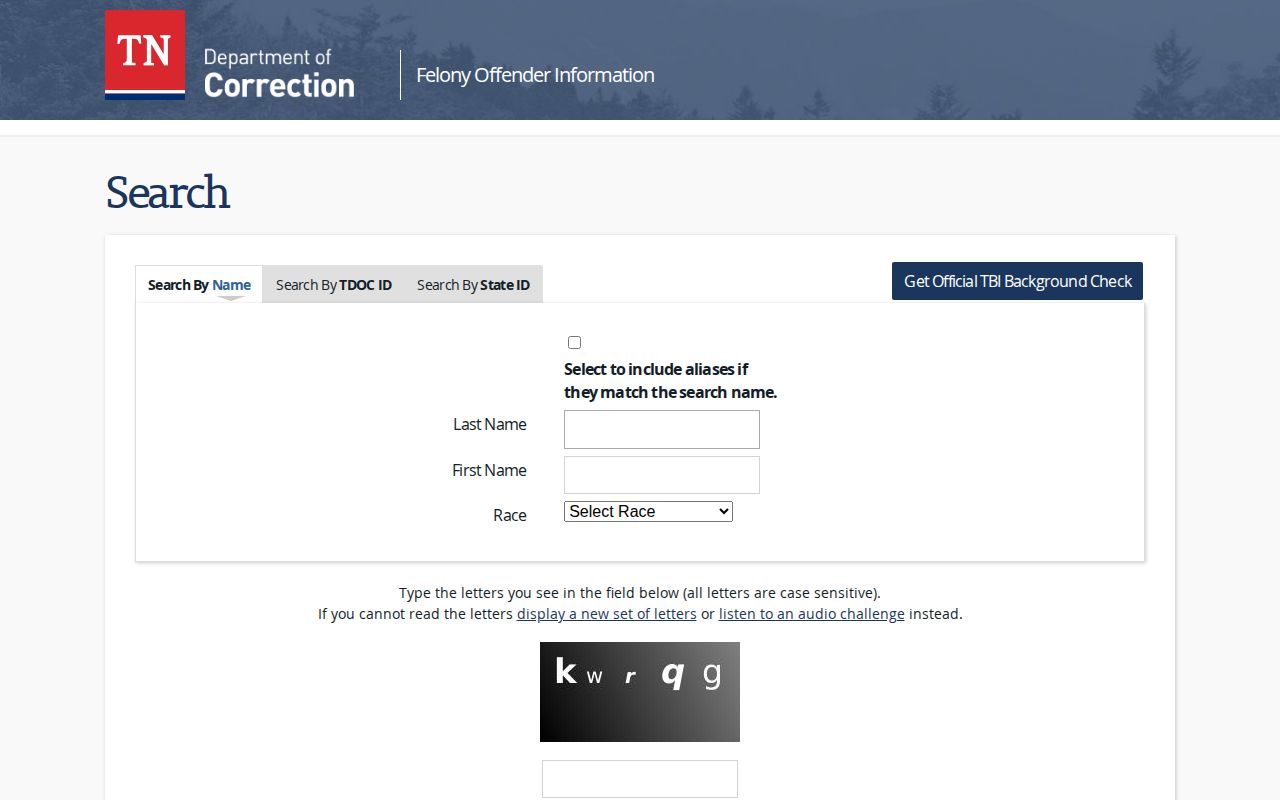
The screen is only the entry point. A projected Madison County release date must be read from the matched detail and checked against the responsible agency’s newest record.
Note: A name-only match is weak; TOMIS or SID plus personal identifiers sharply reduces namesake errors.
Madison Release Fields in FOIL
FOIL covers current and former felony offenders in TDOC custody or supervision. It may display a photo, status, location, offenses, sentence entries, parole-hearing status, release information, and sentence-expiration data. “Parole” means release from prison into community supervision. “Probation” means a court-ordered community status. “Inactive” needs detail or an archived record before anyone assigns a reason.
| FOIL field | How to read it |
|---|---|
| Current status | Shows incarcerated, parole, probation, or inactive when supplied; it is not a full county jail status. |
| Location | Identifies a prison or supervision layer and may reveal that a Madison County departure was a transfer. |
| Release Eligibility Date | Earliest parole-consideration date under the calculation, not a guaranteed gate date. |
| Parole-hearing status | A lead to hearing activity; a schedule or recommendation is not the final Board outcome. |
| Sentence expiration | A distinct calculation that may not move in the same way as RED. |
| Release information | Use actual release status and date when present, then obtain the agency record if precision matters. |
An exact state discharge may require a TDOC archived request for the release authorization, release type and date, custody history, and sentence calculation. FOIL is an index. It is not a certified release certificate.
Tennessee Rules Shape Madison Release
Tennessee does not have one simple rule that makes every person serve the same share of a sentence. Tenn. Code Ann. § 40-35-501 contains range percentages and many offense- and date-specific provisions. Some require 85 percent or 100 percent service, while others apply different eligibility treatment. The conviction, offense date, sentence range, exclusions, and consecutive terms all matter. A charge label alone cannot support a sound calculation.
Sentence reduction credits under § 41-21-236 can be earned, lost, restored, or limited. A change in credits can change RED. Credits do not always affect sentence expiration in the same way. Jail credit is separate: it accounts for qualifying time already held rather than rewarding conduct. Parole eligibility remains only eligibility, and the Board may deny or defer release.
The state release-eligibility statute is the source captured below. It helps locate the governing framework, but it should not be used to calculate a stranger’s date without the judgment and agency sentence sheet.
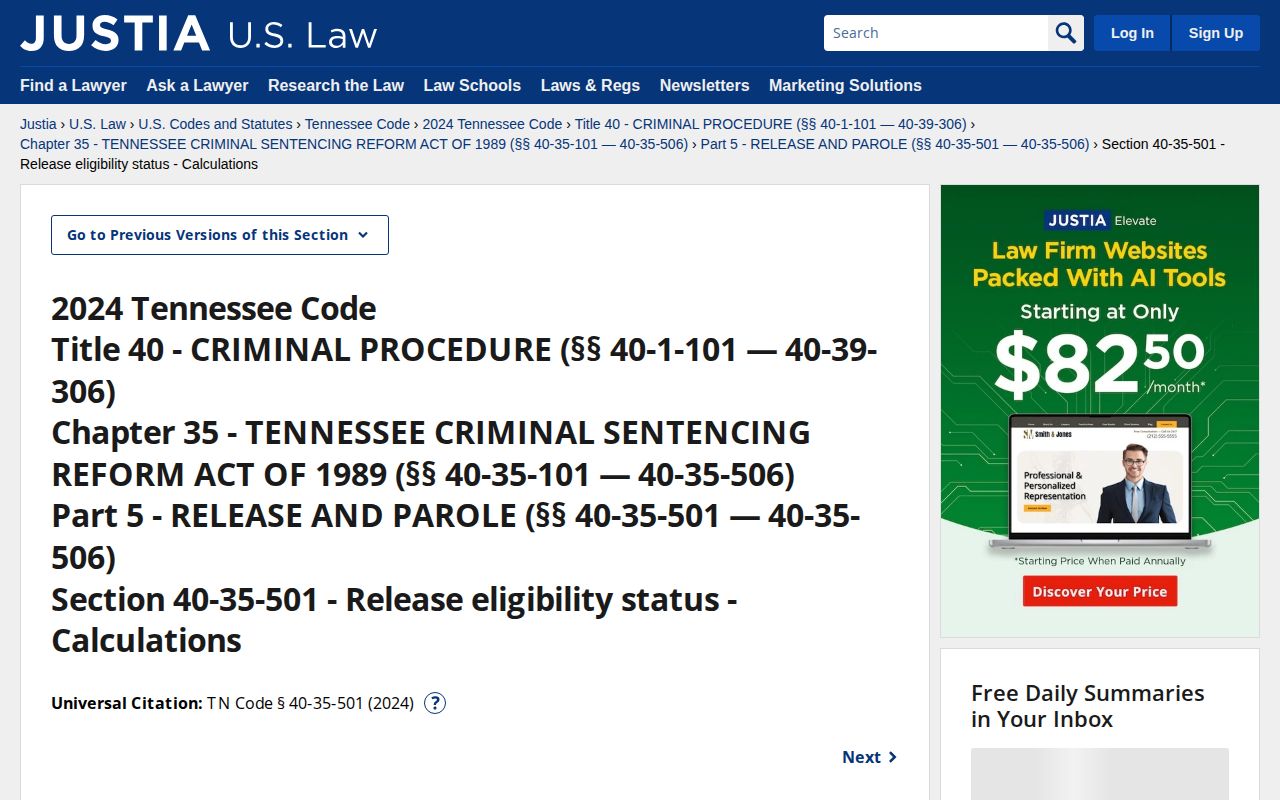
The image identifies the statute used in state eligibility work. TDOC’s current computation, not a manual estimate, controls the state record.
Madison County Release Calculation Split
Madison County calculation work splits at the sentence and custody boundary. Under § 41-21-1006, TDOC calculates expiration and earliest release dates for TDOC felony offenders and certain felony offenders confined in a county jail or workhouse for at least one year. For qualifying county jail or workhouse terms under one year, § 41-2-111 provides a one-quarter deduction framework for upright behavior. That deduction may be revoked after the required disciplinary process.
This split is Madison County’s distinctive projected-release issue. A person at the Criminal Justice Complex or Madison County Penal Farm cannot be calculated by assuming the same credit system as a person in a TDOC prison. Ask who owns the calculation. Then request the existing calculation record, judgment, jail-credit line, and any disciplinary changes.
No Madison County weekend or holiday early-release rule, local cutoff, release door, or standard release-day schedule was verified. Exact timing belongs in an MCSO calculation or release-record request. Another county’s practice and a federal weekend rule are not valid substitutes.
A county request should identify the person, booking number when known, sentence or case number, and the bounded period at issue. Ask for the existing sentence calculation, any recorded behavioral deduction, jail-credit information held by the jail, disciplinary changes that altered the calculation, and the actual release authorization. If staff identify TDOC as the calculator, move the request to TDOC rather than asking MCSO to create a new explanation.
The sentencing court fills a different gap. Its judgment can state the term, split confinement, probation, concurrent or consecutive treatment, and credit awarded by the judge. Later amended or revocation orders may change what the jail must execute. The court record does not always include the exact physical exit time, so it should be paired with the MCSO release record rather than used alone.
Note: The one-quarter local framework applies only to qualifying terms and should not be extended to all Madison County sentences.
Why Madison Release Dates Change
A projected release date can move for legal, custodial, and administrative reasons. Some changes affect eligibility. Others prevent physical release even when one sentence has reached a key date. The newest source record matters most.
| Factor | Possible effect | Record to check |
|---|---|---|
| Credits earned, lost, or restored | May move RED or another calculation as state law permits | TDOC calculation and credit history |
| Consecutive sentences | Changes the total term and eligibility analysis | Judgment and sentence sheet |
| Jail credit | Accounts for qualifying time already held | Judgment, clerk record, calculation |
| Detainer or other hold | Can shift custody to another agency instead of producing community release | Release destination and receiving-agency record |
| Court amendment | Can alter the sentence, credit, or authority to hold | Newest signed court order |
| Parole decision | A denial delays release; a grant can still await plan approval | Final Board action and TDOC status |
| Recalculation or correction | Can change a displayed eligibility or expiration field | Newest agency calculation |
A parole hearing schedule proves only that a proceeding was planned. A Board grant is also incomplete proof until the person’s status and actual release record show that release occurred.
Confirm Madison County Actual Release
Use the holding agency’s record for the final answer. For the Madison County jail system, request the booking and release record through the MCSO Records Division with exact date and time, disposition, and destination or receiving agency. Add the court judgment to explain bond, time served, probation, dismissal, or sentence terms. When TDOC holds the person, request the release authorization, actual date and type, custody history, expiration entry, and calculation sheet.
The Madison County Public Records Request Coordinator routes local requests at 100 East Main Street, Suite 300, Jackson, TN 38301. The research lists 731-423-6059 and recordsrequest@madisoncountytn.gov. Copy requests must be written on the county form, and the policy requires proof of Tennessee citizenship. Asking for electronic delivery and a fee estimate can keep the request focused. If the county is not the custodian, ask which MCSO, court, or state unit holds the record.
VINE can alert a registered person when a participating agency reports a release, transfer, or other custody change. It may lag and is not a certified ledger. Registration and alert limits are covered on the Madison County VINELink Inmate Search. If a transfer event appears, follow the receiving agency rather than calling it community release.
For a state archive, TDOC asks for requester contact information, reason, full offender name, TOMIS number, date of birth, and a detailed description of the record. The records office can supply the calculation history that a public FOIL result does not show. That history is especially useful when the displayed date changed after credit action, a corrected judgment, or a new consecutive sentence.
A defensible conclusion uses matching identity, the right custody system, and the newest dated record. RED predicts an eligibility milestone. Sentence expiration is a separate calculation. Only the actual release or transfer record shows what the holding agency did.