
Madison Parole and Probation Compared
Parole and probation both permit a person to live in the community under rules, but they begin in different ways. The Tennessee Department of Correction release types describe parole as release from prison before the sentence expires. The Tennessee Board of Parole decides whether to grant it. TDOC Community Supervision then performs field supervision. Probation is imposed by a court. It may replace incarceration, follow split confinement, or take a determinate-release form set by law. TDOC states that a person placed on probation or released from split confinement must report to the assigned officer within 48 hours.
The label matters when checking Madison County records. A parole record points toward a felony prison sentence and Board action. A probation record points first to the sentencing judgment. Either status can remain active after the person has left the Madison County Criminal Justice Complex. Neither is the same as discharge, which means the supervision term has ended according to the responsible authority.
| Point | Parole | Probation |
|---|---|---|
| Who orders it | Tennessee Board of Parole | Sentencing court |
| Custody link | Release from prison before sentence expiration | Court supervision, sometimes after split confinement |
| Person-specific public check | TDOC FOIL, then Board or TDOC records | TDOC FOIL when supervised by TDOC, plus the court judgment |
| Field supervision | TDOC Community Supervision | TDOC, county probation, or Community Corrections as the order directs |
- Parole
- Conditional community release before a prison sentence expires.
- Probation
- Court-ordered supervision in the community.
- Revocation
- A formal action that can end community supervision and return a person to custody.
- Discharge
- Official completion of the supervision obligation.
Verify Madison County Post-Release Supervision
The best check joins three records. Start with TDOC’s Felony Offender Information Lookup, called FOIL. It covers current and former Tennessee felony offenders in state custody or supervision. A result may show incarcerated, probation, parole, or inactive status. Open the detail record and compare identifiers. A name alone can match the wrong person. FOIL is not a Madison County misdemeanor roster, and it does not resolve a county-only probation case that was never in the TDOC system.
Next, locate the order behind the status. A Madison County probation term should be traced to the General Sessions or Circuit Court judgment. A parole term should be traced to Board action and the TDOC record. The physical release record adds the actual date when the jail or prison stopped holding the person. This three-part check separates a court sentence, an online status, and a real custody movement.
- Search FOIL by exact TDOC/TOMIS or SID number when known. Otherwise use the full legal name and compare aliases, age, and other identifiers.
- Open the matched detail. Record the current status, location or supervising district, offense, sentence data, and any parole-hearing information.
- Get the Madison County judgment or Board record that authorized supervision. A calendar entry or hearing recommendation is not a final decision.
- Contact the listed state or county office to confirm assignment and reporting directions. Some case details are not public.
- For exact release timing, request the holding agency’s release record. The broader Madison County release path is explained on the released-inmate search home page.
Note: An inactive FOIL label needs the detail or archived record before it can be described as a completed discharge.
Madison Parole District 60 Office
Madison County falls within TDOC Community Supervision District 60 in Jackson. The reviewed state directory listed the office on Hollywood Drive and named Madison among the counties it serves. State sources displayed inconsistent ZIP information, so the live TDOC field-office directory and telephone should control before an in-person visit. The office can help identify an assignment and explain reporting procedure, though private case details may be withheld.
The official field-office listing is shown below. Its county coverage is the key point: Madison County parole and probation cases supervised by TDOC route through District 60, not through the Sheriff’s jail staff.
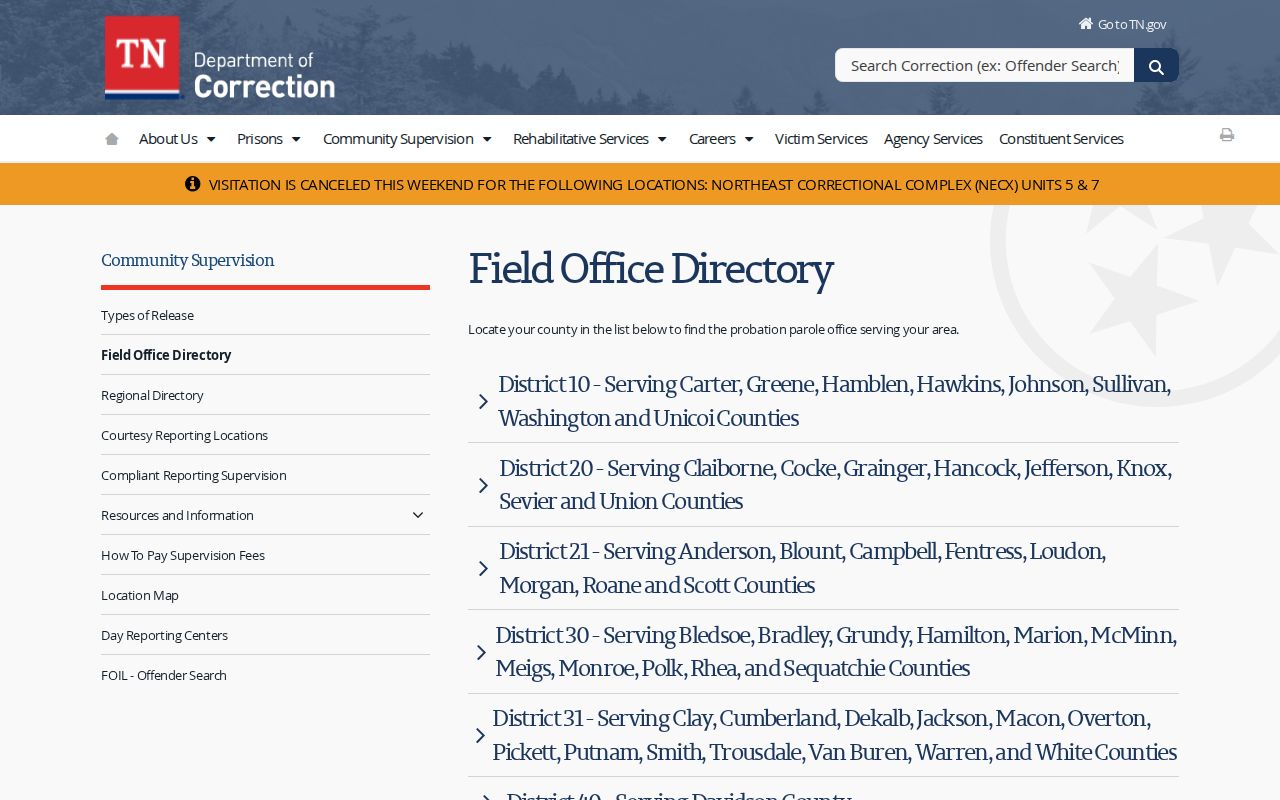
The directory image helps identify the correct state layer, but live office details should still be checked because addresses and assignments can change.
TDOC Community Supervision District 60
1661 Hollywood Drive
Jackson, Tennessee
Phone: 731-984-9802
Verify current address details
Madison Probation Has Local Layers
Not every Madison County probation case reports through the same state office. The sentencing record may direct a person to General Sessions Probation, TDOC Community Supervision, or the county’s Community Corrections program. That last program serves the 26th Judicial District, including Madison, Henderson, and Chester Counties. It provides court-linked supervision and programming tied to bond and diversion work, Recovery Court, and Veterans Court. It is not an inmate database.
Read the order before calling. The office named in the judgment is more reliable than a guess based on where the person was booked. For local Community Corrections, the county lists the following contact and schedule. Changes or court holidays should be confirmed before travel.
Madison County Community Corrections
314 South Shannon Street
Jackson, TN 38301
Phone: 731-423-6183
Monday through Thursday, 8:00 a.m. to 5:00 p.m.
Friday, 8:00 a.m. to 3:00 p.m.
Closed for lunch from noon to 1:00 p.m.
Official program page
This local layer explains why FOIL can show a broad supervision status while a court order identifies a more specific reporting office or program.
Madison Supervision Warrants and Absconders
An absconder is a person alleged to have stopped reporting or left supervision without authorization. No verified public Tennessee absconder-only list was found in the research. A missing FOIL result does not prove absconding. It can reflect spelling, timing, a county-only case, an older record, or a status that requires an archive request.
The MCSO Warrants Division serves court process from the Criminal Justice Complex. A warrant is an order to take action. It is not proof that officers have executed it, that the person is now incarcerated, or that parole has been revoked. Confirm a warrant with the issuing court or serving agency, current custody with the holding agency, and supervision status with TDOC or the office named in the order.
VINELink may later report a booking or transfer event if a participating jail receives the person. It does not replace the violation report, revocation record, or supervising office confirmation.
Madison Parole Hearings and Violations
The Tennessee Board of Parole publishes schedules for state prisons and county jails. The schedules generally update weekly, on Monday or Tuesday after a Monday holiday. A listed hearing is only a planned proceeding. Hearing officers act as fact finders and make recommendations. Board members may adopt, change, or reject those recommendations. The Board hearing procedure distinguishes grant hearings from preliminary and final revocation hearings, rescission matters, time-setting proceedings, and appeals.
Conditions differ by order, so no single checklist proves compliance. Common obligations may involve reporting, approved residence, travel limits, payments, treatment, or conduct rules stated in the person’s documents. An alleged violation begins a process; it is not the same as a final revocation. For an offender-specific public lead, FOIL may show parole-hearing status. For a final result, obtain the Board or TDOC record.
The Board’s main office is at 500 James Robertson Parkway, 4th Floor, Nashville, TN 37243-0850. Its public telephone is 615-741-1150, and the research lists BOP.Webmail@tn.gov. Those contacts serve a different function from District 60. The Board addresses hearings and decisions. District 60 manages field supervision after release. MCSO handles local warrants and county custody. Keeping those roles apart prevents one office’s record from being stretched into an answer it cannot provide.
For a Madison County case, request the hearing notice, final Board action, any revocation order, and the current TDOC status when the outcome matters. A preliminary revocation hearing addresses probable cause. A final revocation hearing can lead to reinstatement or revocation. A rescission matter can undo a grant in defined circumstances. Those terms describe stages of process, not an automatic return to custody.
Note: A parole grant can precede physical release while the plan and other pre-release conditions are completed.
Madison Probation and Parole Discharge
Supervision ends through an official discharge, sentence expiration, court order, or other authorized closure. It does not end merely because a person stops appearing in a public search. For parole, TDOC and Board records should establish the end of the obligation. For probation, the sentencing court may hold the controlling order. A local Community Corrections office can explain program status, but the court record remains central when the judge imposed or changed the term.
Ask for the exact record needed: discharge certificate, sentence-expiration entry, supervision closure record, amended judgment, or order showing satisfaction. Include full identity, case or TOMIS number, and a tight date range. An older TDOC file may require the archived-record route. These records distinguish successful completion from a transfer, revocation, or administrative status change.
TDOC archived requests can seek a custody history, release authorization, release date and type, sentence calculation, and expiration information. Charges may apply, and TDOC says not to prepay the first request. For a county probation term, ask the proper Madison County clerk for the judgment and every later order affecting supervision. General Sessions commonly holds lower-level case and bond records. Circuit Court supplies felony judgments and later felony orders. The case number is the best link across those files.
Custody and supervision must stay separate. A discharged person is no longer under that listed parole or probation term. A person on active parole or probation is out of prison or jail unless a newer custody event shows otherwise. The newest agency and court records control.